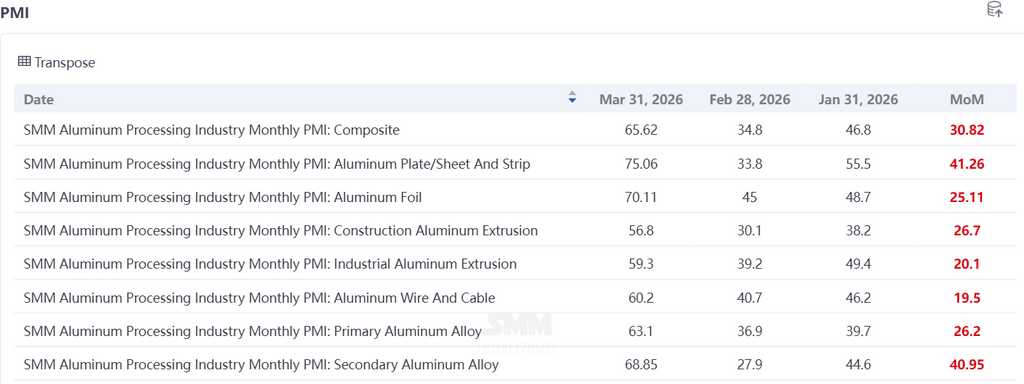
In March, China’s composite PMI for aluminum processing registered 65.6, rebounding strongly above the 50 mark. Overall industry sentiment recovered markedly, with PMI readings across all sub-sectors rising sharply, showing clear characteristics of rapid post-holiday repair and strong support from the peak season. Specifically, aluminum plate/sheet and strip and aluminum foil performed particularly well. Supported by the recovery in demand from the traditional peak consumption season as well as energy storage, battery materials, packaging, and other sectors, production and new orders indices generally remained at high levels, and enterprise operating rates increased significantly; industrial extrusion and aluminum wire and cable also benefited from the boost from new energy, power investment, and other fields, with both orders and production improving in tandem and industry sentiment recovering quickly; although construction extrusion remained relatively weak overall, it recovered slightly with support from post-holiday work resumptions and channel penetration; the primary and secondary aluminum alloy industries also rapidly recovered from post-holiday lows into expansion territory. Overall, under the combined effects of the “Golden March” peak season, post-holiday production resumptions, policy support, and high prosperity in some emerging sectors, the aluminum processing industry showed a trend of rapid recovery in March. However, it should be noted that factors including high-level fluctuations in aluminum prices, divergence in end-use demand, disruptions to exports caused by the Middle East situation, as well as constraints from aluminum scrap costs and compliance policies, still posed certain restraints on the industry’s subsequent upside room.
By Product Type:
Aluminum Plate/Sheet and Strip: In March, the PMI for China’s aluminum plate/sheet and strip industry came in at 75.1%, surging well above the 50 mark. By sub-index, the production index and new orders index both registered 90.1%. As March formally entered the traditional peak season, demand for products such as can stock, automotive sheets & plates, and battery materials related to energy storage continued to recover, driving enterprises to steadily raise operating rates, while end-use consumption showed broad-based strength across multiple segments. The new export orders index came in at 78.3%, but actual performance showed notable divergence: all orders from the Middle East were suspended or even returned due to the conflict, while export orders from Southeast Asia achieved YoY growth. The product inventory index stood at 30.9%. As logistics returned to normal after the Chinese New Year, finished product inventories accumulated during the holiday were also digested in an orderly manner. Overall, under the combined effects of demand release during the traditional peak season in March, support from policy tailwinds, and strong activity in emerging sectors such as energy storage, the industry prosperity index rebounded. However, constraints including wild swings in aluminum prices, weak automotive sheets & plates orders YoY, and blocked exports to the Middle East made it difficult to rise further. The aluminum plate/sheet and strip PMI is expected to return to around the 50 mark in April.
Aluminum Foil: In March, the PMI for China’s aluminum foil industry came in at 70.1%, returning to expansion territory. By sub-index structure, the production index registered 82.4%, and the new orders index 83.2%. Demand for food packaging foil and pharmaceutical foil remained in peak season, air-conditioner foil demand began to recover, and adjustments to the battery export tax rebate policy temporarily lifted demand for battery foil and brazing foil. Leading enterprises had relatively ample orders on hand, effectively supporting a steady increase in operating rates. The new export orders index came in at 55.7%. At present, the conflict in the Middle East has weighed on China’s exports of double-zero packaging foil and complete air-conditioning units, becoming the main factor constraining further export growth. The product inventory index registered 31.8%, remaining at a relatively low level, while enterprises actively digested finished product inventories after the Chinese New Year holiday. Looking ahead, as the battery export tax rebate policy is implemented and the export situation in the Middle East remains unclear, the aluminum foil PMI is expected to pull back to around the 50 mark in April.
Construction Extrusion: In March, the composite PMI for the construction extrusion industry came in at 56.8%, rebounding to above the 50 mark. After the Chinese New Year, enterprises resumed work and production in an orderly manner, while market demand was gradually released. In addition, backlog orders accumulated during the holiday continued to be executed, driving the production index to 62.8%, the new orders index to 60.0%, and the purchasing volume index to 59.7% this month. Although the overall construction extrusion market remained relatively weak, extrusion enterprises actively leveraged their own advantages to expand production and sales channels. Some enterprises in Hebei and Shandong reported that orders for non-standard door and window materials sold to township markets had been favorable recently, while some large enterprises in Guangdong and Shandong said they still attached importance to project development. In addition, some sample enterprises in Shandong reported that export orders had declined recently due to disrupted shipments of downstream traders' orders to the Middle East, with the export orders index at 48.9% this month. Looking ahead to April, as temperatures rise and construction end-use demand gradually improves, supported by the traditional peak consumption season of "Golden March and Silver April," the industry's composite PMI is expected to remain above the 50 mark next month.
Industrial Extrusion: In March, the composite PMI for the industrial extrusion industry came in at 59.3%, rebounding to above the 50 mark. The production index stood at 78.9%, the new orders index at 58.0%, and the purchasing volume index at 71.1% this month, indicating a synchronized recovery in production, demand, and raw material stockpiling. As the adjustment to export tax rebates for PV- and battery-related products entered the final installation rush period before policy implementation, incremental orders effectively supported higher operating rates at enterprises. Among them, top-tier PV frame enterprises in Anhui and Hebei maintained operations at full capacity. In addition, power-related orders performed strongly. Multiple medium and large extrusion enterprises in Shandong and Guangdong reported a marked increase in new orders for products such as power pipelines, transformer materials, and aluminum busbars. On the export side, despite uncertainty in the geopolitical situation outside China, the industry as a whole did not see a substantial increase in aluminum semis exports, and most enterprises reported stable order-taking outside China. Only PV frame extrusion enterprises reported a slight increase in export orders to India, with the industry's new export orders index at 60.9% for the month. On inventory, affected by enterprises' adjustments to product mix and efforts to ensure timely delivery for downstream supporting demand, finished product inventories at sample enterprises accumulated slightly MoM, with the finished product inventories index at 52.3% this month. Pressure remained in employment and order delivery, with the employment index at 47.7% and the backlog order index at 52.3% for the month. Small and medium-sized extrusion enterprises in Shandong and Jiangsu-Zhejiang reported that post-holiday labor loss combined with hiring difficulties constrained the full release of capacity, resulting in some backlog orders. Looking ahead to April, although some front-loaded installation-rush orders in the PV sector may have created a demand pull-forward effect, rigid demand from new energy end-users still provides strong support. Together with the continued underpinning from the traditional peak consumption season of "Golden March and Silver April," the industrial extrusion PMI is expected to remain above the 50 mark in April, with a solid foundation for overall industry prosperity.
Aluminum Wire and Cable: In March, the PMI for China’s aluminum wire and cable industry came in at 60.2%, rebounding sharply by 19.5 percentage points MoM and significantly breaking above the 50 mark, with industry sentiment strongly rebounding from contraction territory to expansion territory. By segment, the production index came in at 80.51%, up sharply by 40.3 percentage points MoM. As power grid orders were picked up in a concentrated manner, downstream enterprises fully resumed work and production, and the operating rate rebounded significantly; the new orders index came in at 57.97%, up 28.1 percentage points MoM, while the new export orders index came in at 53.03%, up 5.4 percentage points MoM, indicating marginal improvement in new orders. The backlog order index came in at 46.97%, up 17.2 percentage points MoM. Although it remained in contraction territory, the decline narrowed, showing that earlier backlog orders were gradually digested. The purchasing volume index came in at 68.85%, up sharply by 26.7 percentage points MoM, as enterprises actively restocked to meet production needs. Overall, both production and orders in the aluminum wire and cable industry improved in March, and industry sentiment rebounded significantly. After entering April, as power grid projects continue to advance and end-use demand is steadily released, the industry PMI is expected to remain in expansion territory, and the growth momentum in production and orders is expected to continue.
Primary Alloy: In March, the PMI for the primary aluminum alloy industry came in at 63.1%, up 26.2 percentage points MoM. As the impact of the Chinese New Year holiday faded, previously suspended capacity gradually resumed operations, upstream and downstream production rebounded in sync, and the industry gradually entered a recovery track. From the sub-indices, the production index rose significantly, mainly due to continued improvement in downstream demand, which drove production higher; meanwhile, maintenance and upgrade work on some production lines was completed in early March and production resumed, further boosting output growth. The new orders index also rebounded, supported jointly by increased downstream demand and a rise in long-term contract volumes, lifting order levels. The finished goods inventory index came in at 24, down significantly from the previous month, reflecting overall destocking across the industry. The main reason was that downstream demand in February fell short of expectations, leading to relatively high inventory accumulation at enterprises; therefore, March mainly focused on digesting existing inventory, and overall inventory levels pulled back from February. Overall, the industry is expected to remain above the 50 mark next month, with production and orders likely to continue recovering and the industry maintaining growth. However, aluminum prices are currently at high levels, and downstream purchasing interest in spot orders remains weak, making the growth pace relatively slow.
Secondary Alloy: In March, the PMI of the secondary aluminum industry rebounded sharply by 40.9 percentage points MoM to 68.8, returning above the 50 mark. After the Lantern Festival, enterprises resumed work and production in a concentrated manner, downstream demand gradually repaired, and new orders continued to recover, driving a marked increase in the industry's operating rate. However, the rebound in operating activity was still constrained by multiple factors: first, aluminum scrap costs remained high, while tighter reverse invoicing requirements in Anhui and other regions, along with the cancellation of tax rebates in some areas, prompted more enterprises to turn to invoiced or imported resources, but the related supply was tight and prices were high, constraining the release of operating activity; second, end-use demand fell short of expectations, and the higher center of aluminum prices in March squeezed downstream profits, with most enterprises maintaining just-in-time procurement, while some proactively cut orders due to losses, and shipments were under pressure amid blocked exports to the Middle East and the phaseout of auto subsidies. On inventory, affected by tight supply of compliant aluminum scrap, intensifying aluminum price fluctuations, and limited profit margins, enterprises kept raw material inventory at low levels. Finished product inventories showed phased changes: they were destocked somewhat at the beginning of the month as demand recovered, while in the middle and latter parts of the month, with operating activity recovering but demand remaining weak, inventories accumulated slightly. Looking ahead to April, secondary aluminum orders are expected to weaken, and the industry's PMI may pull back below the 50 mark.
Brief Comment:
Looking ahead to April, prosperity in the aluminum processing industry is expected to shift from "broad-based recovery" to "structural divergence," and the center of the composite PMI may return toward the 50 mark. Specifically, after the concentrated release of earlier orders, aluminum plate/sheet, strip and foil is seeing sentiment edge lower under the impact of export uncertainty and policy disruptions; secondary aluminum alloy is facing dual pressure from weakening orders and cost pressure, and its PMI risks falling below the 50 mark; although primary alloy still has recovery momentum, the restraining effect of high aluminum prices on demand is slowing the pace of rebound. By contrast, industrial extrusion and aluminum wire and cable are expected to remain in expansion territory, supported by rigid demand from new energy and power grid investment; construction extrusion, meanwhile, is benefiting from the seasonal recovery in construction activity and is likely to continue its weak recovery trend. Overall, the "Silver April" effect will likely persist in April, but with weaker drivers, and the industry's operating center is expected to move lower.
![[SMM Flash News] Combined Production Cuts at Three Middle Eastern Aluminum Smelters Reached About 2.43 Million mt](https://imgqn.smm.cn/usercenter/PerRJ20251217171650.jpg)